
By Ersin Han Ersin of Marshmallow Laser Feast

Of the Oak, Marshmallow Laser Feast, 2025
I have been practising befriending trees for many years now. It is hard to say whether I’m fully tree literate but you can definitely count me as a student of the ‘standing people’. This foray into the plant kingdom has taken us many places, into forests, under canopies, across disciplines and continents, and finally, it led us to meet and mingle with some of the greatest oaks in England.
I’m an artist and director, and part of London based experiential artist collective Marshmallow Laser Feast. We are a bunch of passionate people who find joy in asking questions around art, ecology and interbeing. Our practice is rooted in telling stories that deepen our relationship with the living world. For us, revealing the animism of nature, with its vitality, complexity, and interconnections, is both an artistic pursuit and a deeply felt responsibility.
In 2024 we set out to create an artwork, now called Of the Oak, which brings to light what so often goes unseen. Commissioned by Royal Botanic Gardens, Kew and created in collaboration with ecologists, biologists and researchers, the project reveals the oak not merely as a tree, but as a living nexus of connection and reciprocity.
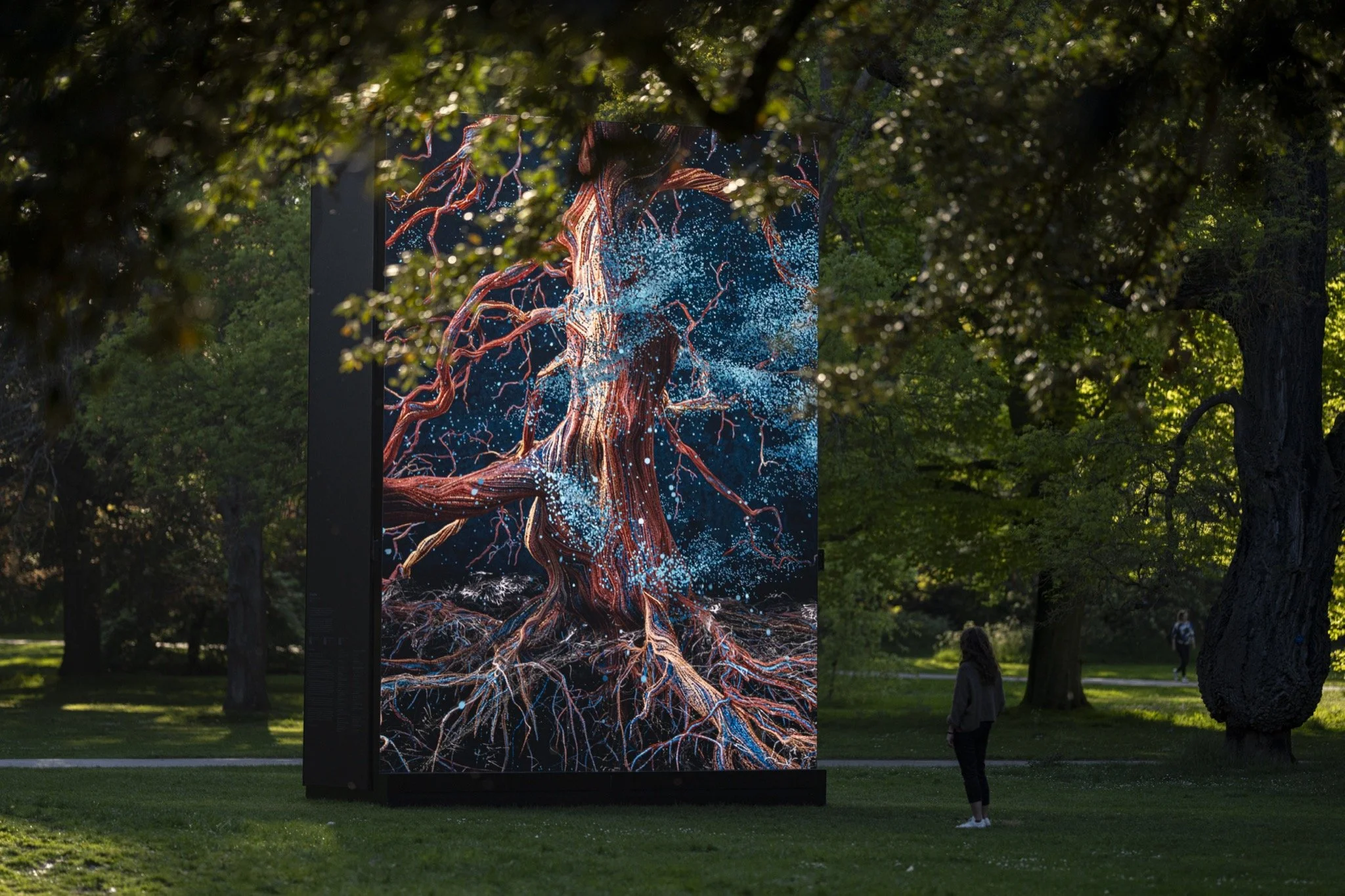
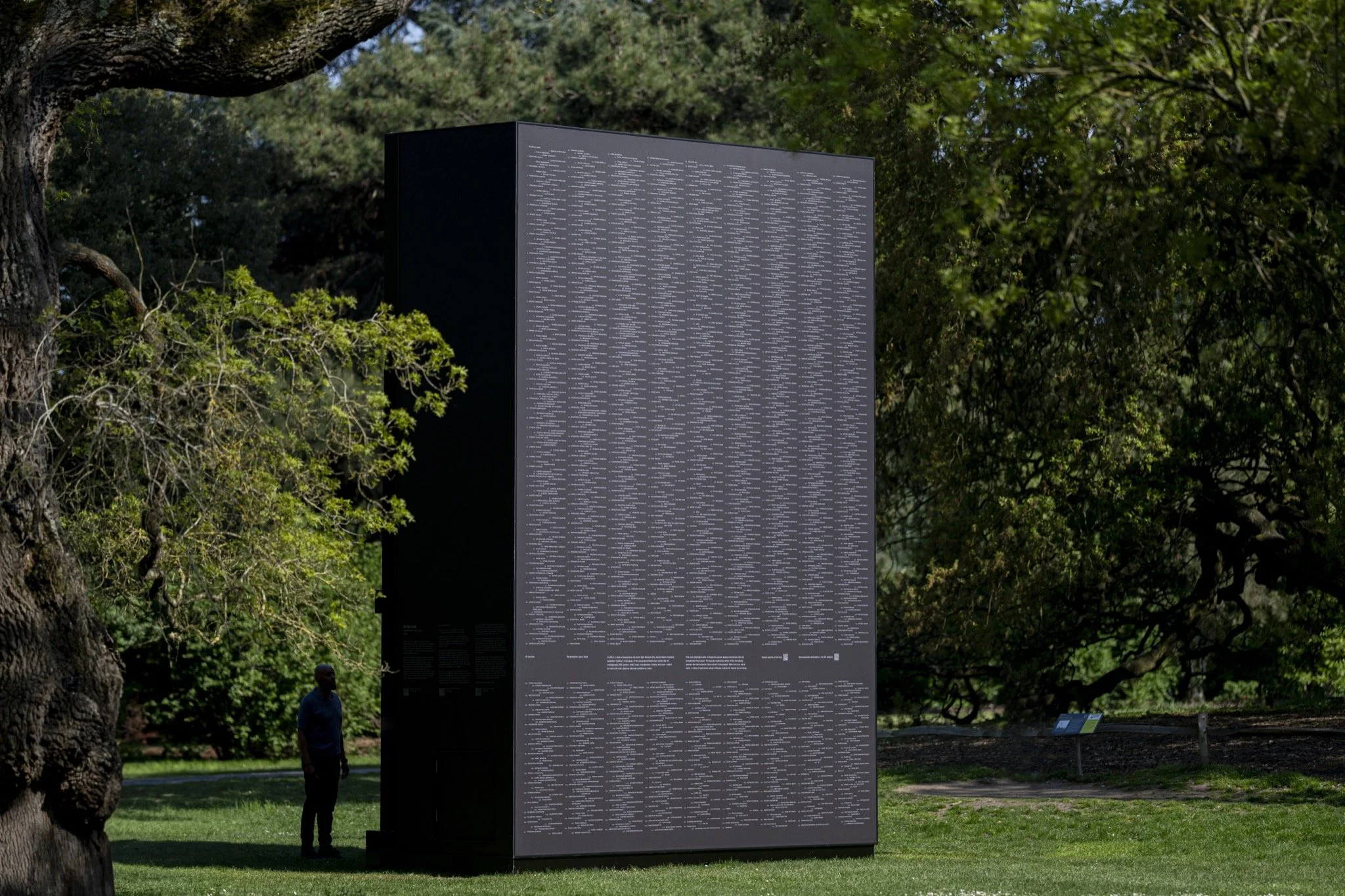
Of the Oak at Kew Gardens, Marshmallow Laser Feast, 2025
The inspiration for Of the Oak began with a startling realisation: just how many species depend on oak trees to survive. In 2019, a team led by Dr Ruth Mitchell published a comprehensive study titled OakEcol: A database of oak-associated biodiversity within the UK1. The research catalogued over 2,300 species, including birds, bryophytes, fungi, invertebrates, lichens and mammals that rely on native UK oaks (Quercus petraea and Quercus robur) for their ecological functions. This study revealed the oak’s status as a keystone species. Its body not simply its own, but a foundation for countless others.
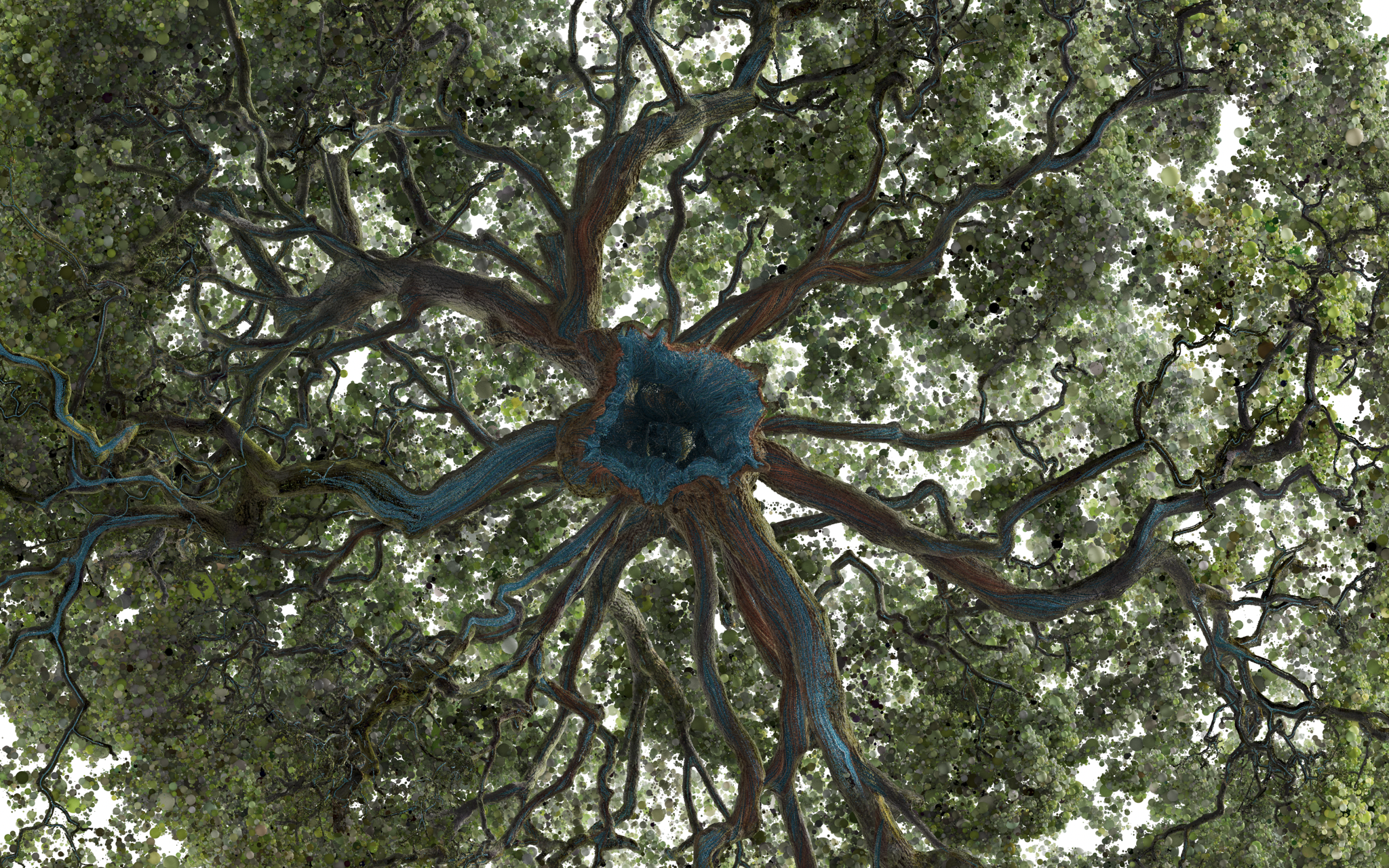
Of the Oak is an immersive video installation celebrating the oak tree as a living monument of vital ecological relationships and species interdependence. The artwork invites viewers to witness the oak as a keystone in the web of life, majestic and unassuming, stretching its branches skyward and its roots deep into the soil, embodying both quiet strength and boundless generosity.

Of the Oak, Marshmallow Laser Feast, 2025
“ There is more to an oak than meets the eye.
– A thread woven into the story of our kind.”
Alongside the monolithic artwork, we made a companion piece that works at a much quieter scale. We asked a group of authors, scientists and a poet to write a series of open eyed meditations, guided audio pieces by Daisy Lafarge, Merlin Sheldrake, Ella Saltmarshe and Laline Paull. The idea is simple. You spend a little time near a tree, keep your eyes open, and let the voice point you towards what usually goes unnoticed. Nothing more is asked of you than being there and paying attention, and that turns out to be enough to change how it feels to stand among trees.
The meditations sit inside Of the Oak’s online field guide, which acts as a kind of portal into the hidden networks an oak sustains. We’ve also added some behind the scenes stories and research, for anyone curious about how the piece was made and the ecological exploration that led to it. Together they carry the themes of the artwork a bit further, research and reverie in the same place, best met on your own and in no particular hurry.
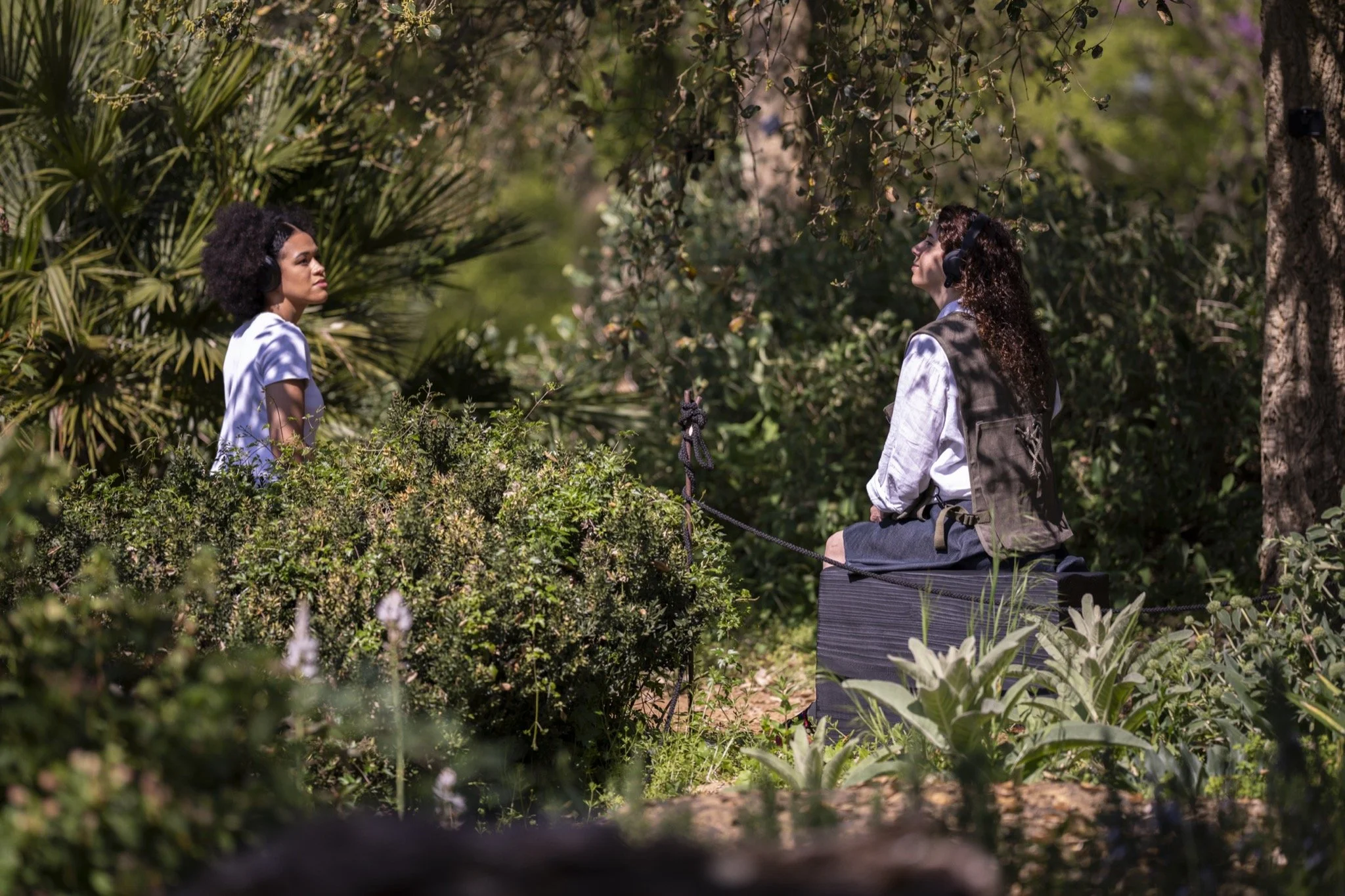
An Excerpt from Humans of the Oak guided meditation created as part of project at Kew Gardens;
And now you stand with your back to the oak, looking out
At the spool of human history tangled and blossoming from its branches.
Where would you be without it?
All this time the oak stands still,
A stillness has moved you further than you ever thought possible.
And so you thrive:
around and about and within its greening,
making you a human of the oak.
Daisy Lafarge
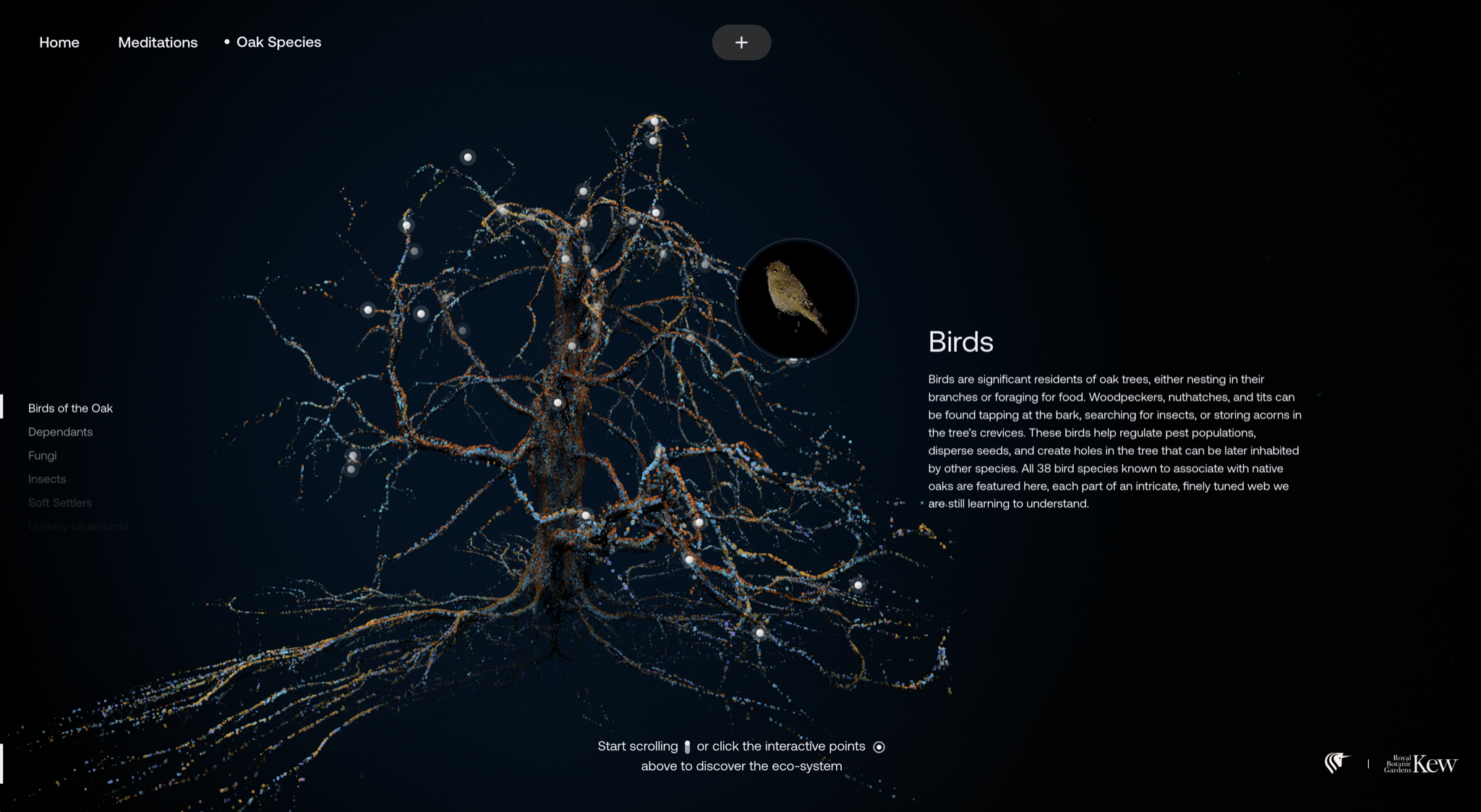
Screenshot from Of the Oak’s online field guide. oftheoak.co.uk
The other half of the field guide is devoted to the species that live with the oak. The 2,300 species in Dr Mitchell’s study include well over a thousand invertebrates, more than 700 lichens, more than 200 mosses and liverworts, around a hundred fungi, 38 birds and 31 mammals. Even that is an undercount, since the study left out bacteria and other microorganisms. And 326 of those species have no alternative. They live on oak and nowhere else.⁶
The guide does not attempt to cover all of them. What it offers is an introduction, a way of wandering from bats to invertebrates, from lichens and mosses to fungi and birds, and seeing how each one fits into the life of the tree. Some feed on it, some nest or roost in it, and some simply grow on its bark. It is a place to begin.
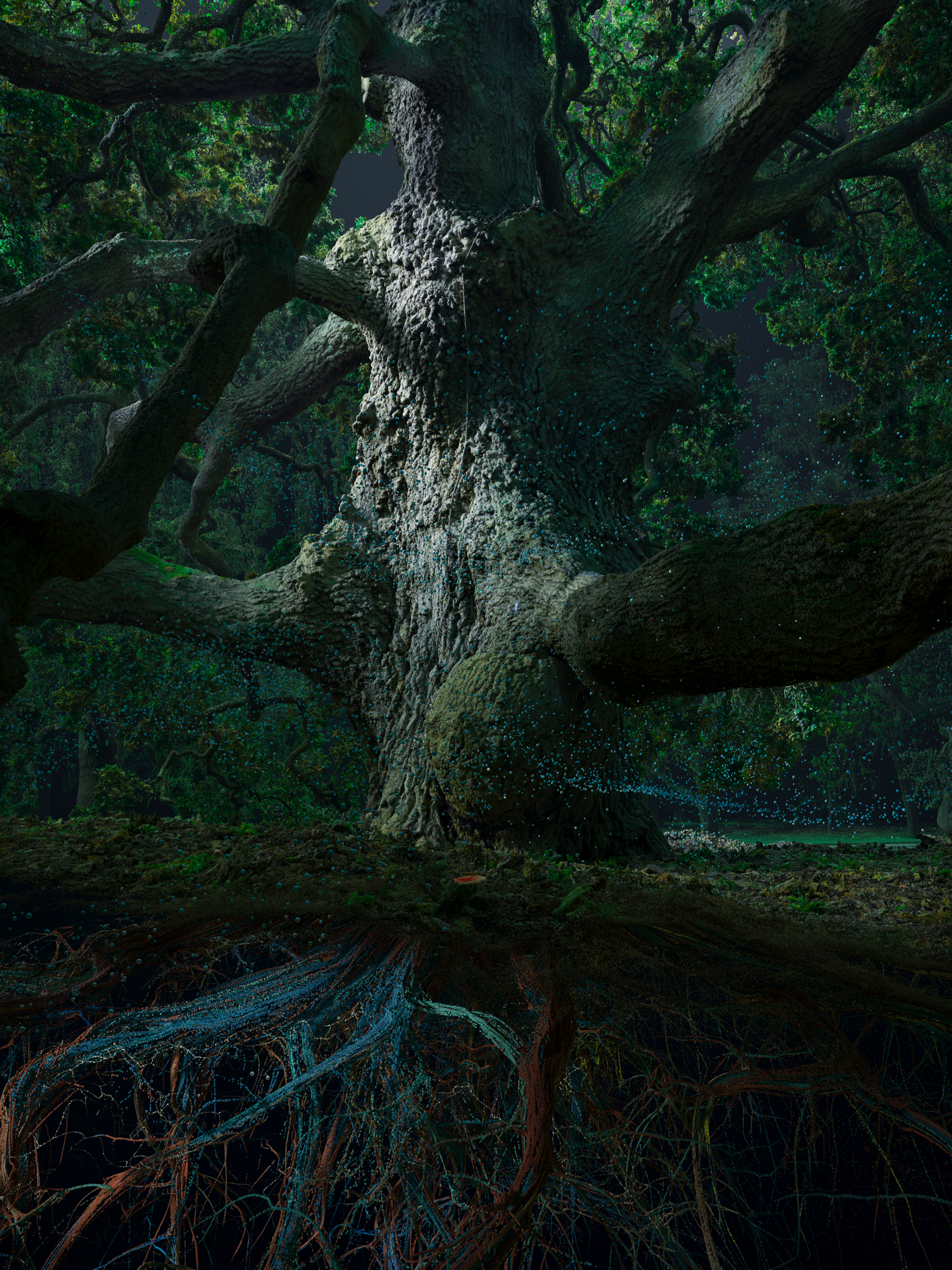
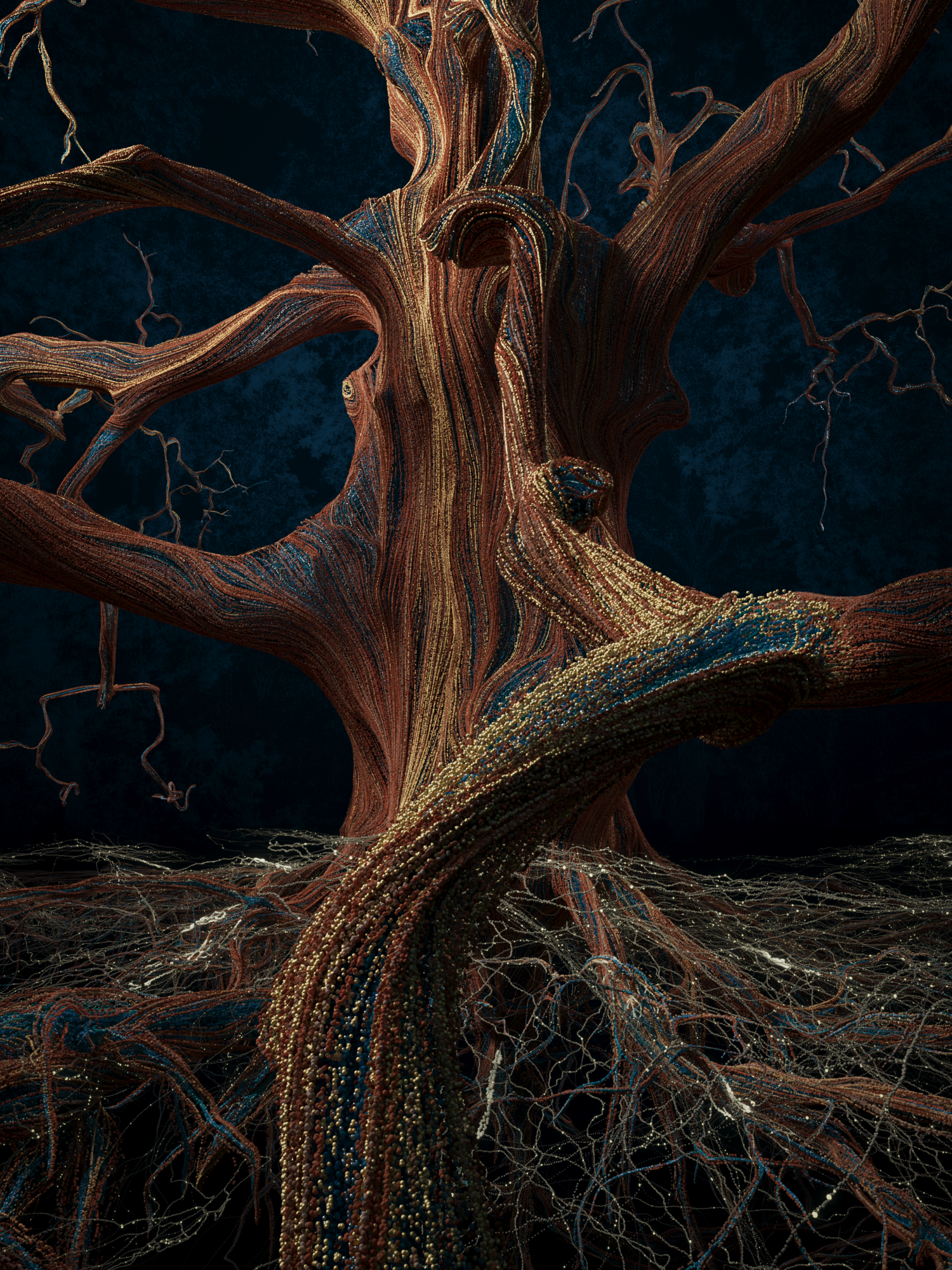
Excerpts from the digital artwork, Of the Oak, Courtesy of Marshmallow Laser Feast, 2025
One of the biggest revelations in the making of the project was how deep the oak’s presence in the human psyche runs, and for how long it has captured the human imagination. And yet, for all that familiarity, we rarely look closely at the tree itself.
The oak’s meaning stretches far beyond its bark. Its limbs embrace whole ecosystems, providing shelter and food for thousands of species. From lichens anchored to the bark to birds building nests overhead, butterflies fluttering through the leaves to fungi weaving the soil below, countless companions of the oak adapt, flourish, and coexist in a mutual rhythm. In acknowledging this complexity, we also confront our own plant blindness, our tendency to overlook the aliveness of plants because they move to a rhythm much slower than ours.
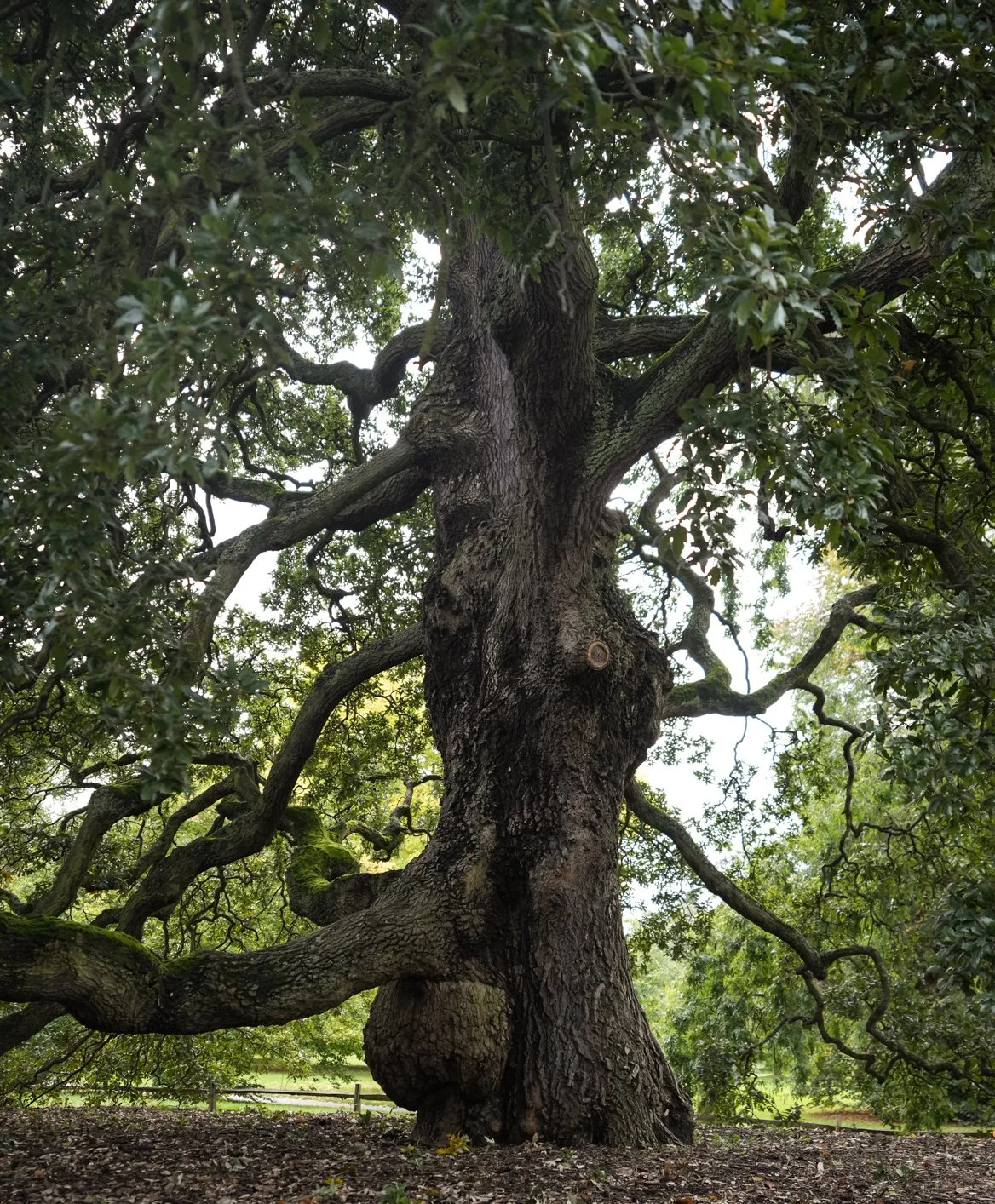
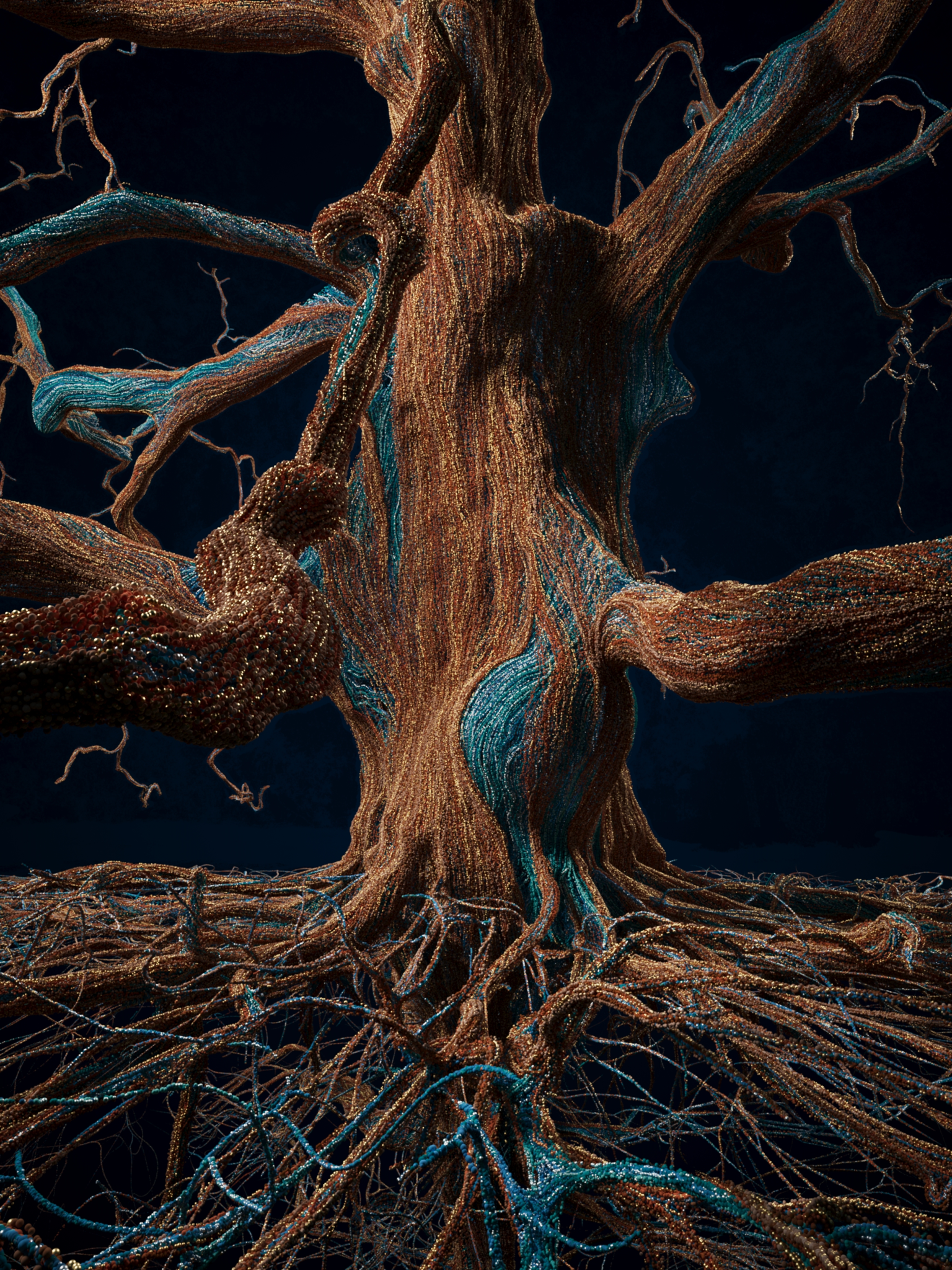
Still from Lucombe oak at Kew Gardens. Excerpt from the digital artwork, Of the Oak, Courtesy of Marshmallow Laser Feast, 2025
At the heart of the artwork stands the magnificent Lucombe Oak (Quercus × hispanica ‘Lucombeana’), a rare hybrid first discovered in 1760. Chosen for its sweeping branches and intricate form, this iconic tree becomes the centrepiece of the artwork.
Making of the Oak
A lot of an oak is out of our reach. Much of it is underground. Plenty of the rest happens too slowly, too quietly or at too fine a scale for us to notice. So to make Of the Oak we borrowed a few ways of seeing that aren’t our own. We photographed the tree thousands of times and stitched the images together with photogrammetry, then mapped its form with LiDAR. CT scans of soil samples showed us what the soil was hiding. And with the help of Kew’s specialist Tree Gang, we made a series of live sound recordings, each running a full 24 hours, so you can hear the oak through a whole day and night in various seasons.
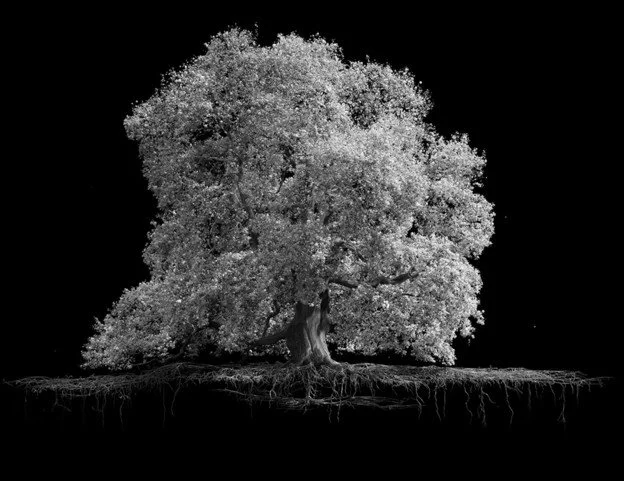
LiDAR scan data of the Lucombe oak, Courtesy of Marshmallow Laser Feast, 2025
LiDAR works by sending out rapid pulses of laser light and measuring how long each one takes to return. Every reflection becomes a point in space, and together those points gave us the form of the Lucombe Oak in three dimensions, including details that are hard to see from the ground.
The roots were another matter. Until fairly recently the only way to see a root system was to dig it up, which rather defeats the point. Ground-penetrating radar lets you leave the tree alone, though it sounds more sophisticated than it feels: you walk circles around the trunk pushing something that looks like a pushchair. The odd thing is that the radar isn’t looking for wood at all. It sends pulses into the ground and they bounce back wherever the water content changes, so a living root shows up because it’s wetter than the soil around it. On screen each one appears as a small arch, and the finest roots don’t register at all. Ian Lee from Tree Radar UK helped us with the scanning, and what came back looked like a pancake: a flat map of where the water is, with all the inaccuracies you’d expect. Ian then guided us through extrapolating that two-dimensional data into a three-dimensional model, alongside Kevin Martin, Head of Tree Conservation at Kew, and other dendrologists. What came out of it is the most accurate portrait of a tree we’ve ever attempted to capture. It turns out you can draw an oak by following its thirst.
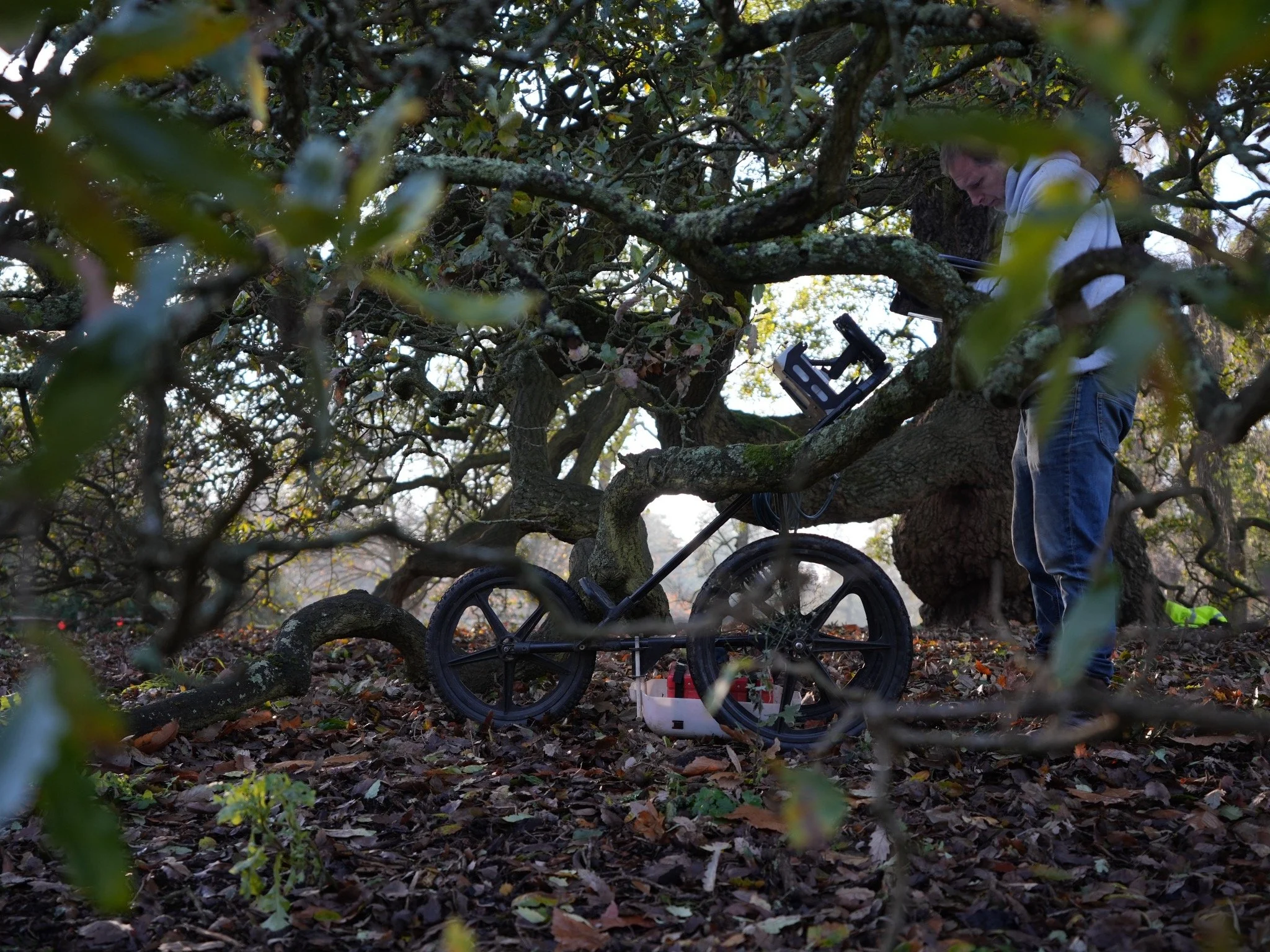
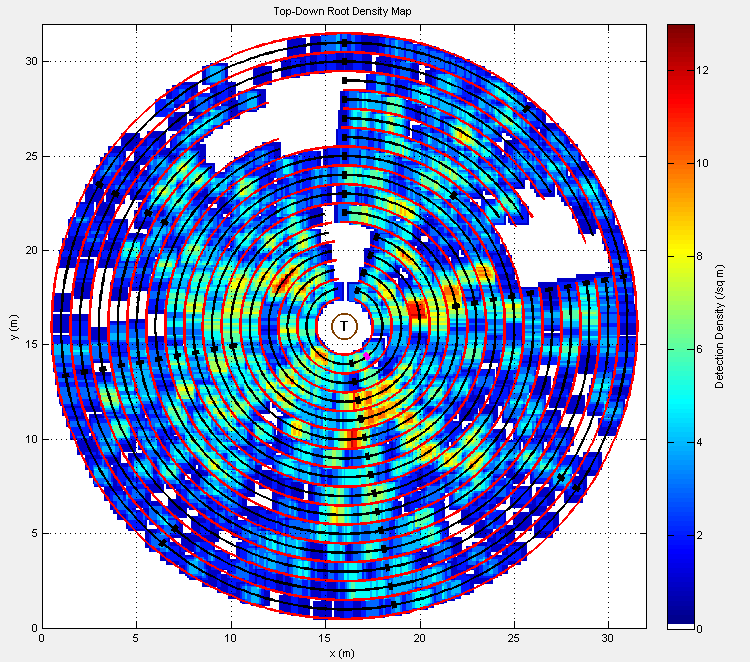
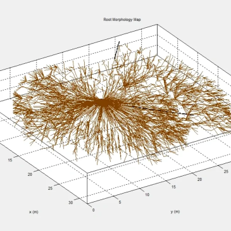
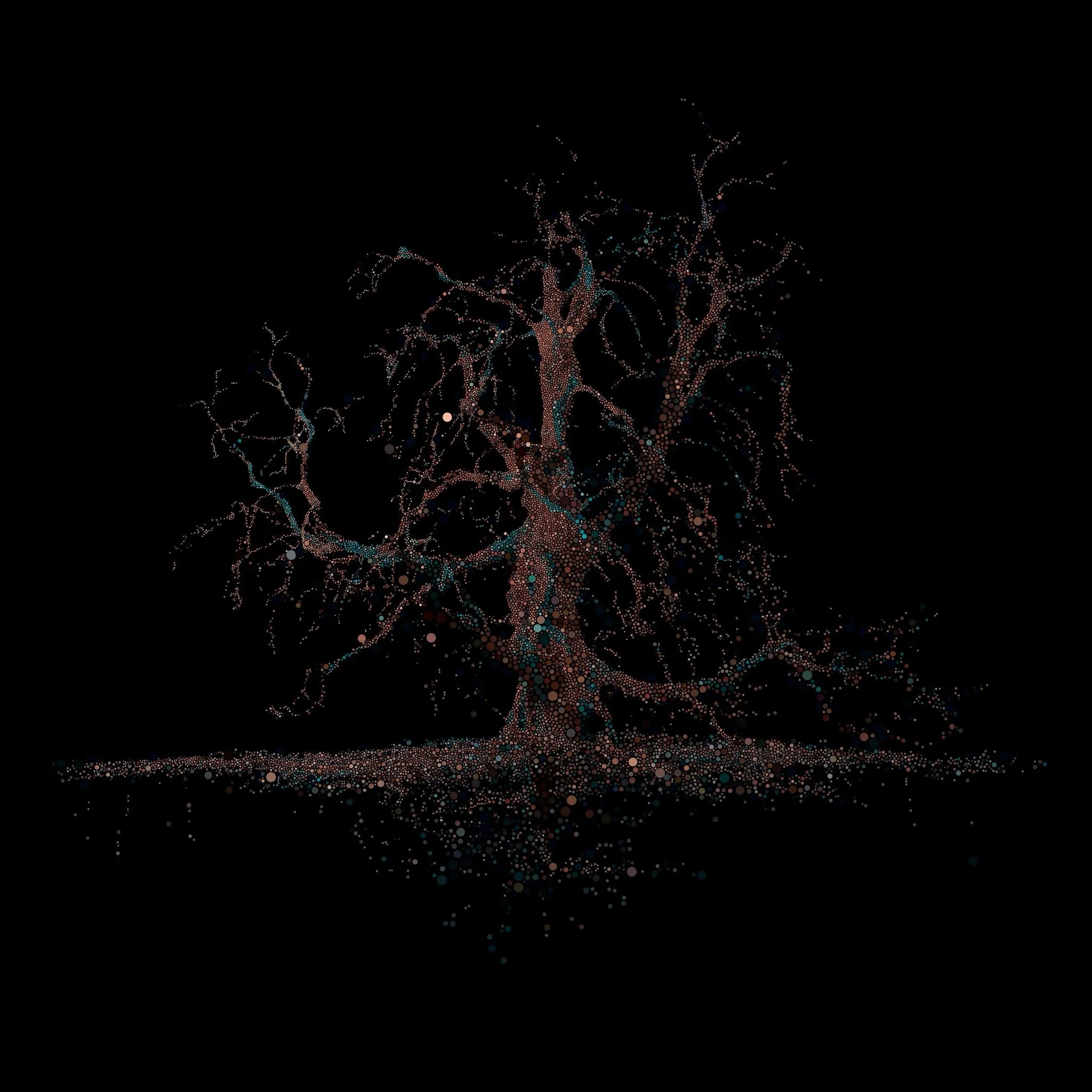
Ground Penetrating Radar Process and data, Courtesy of Marshmallow Laser Feast, 2025
What emerges is a portrait of the tree as both anchor and conduit. Its underground architecture mapping a hidden world of interconnectedness.
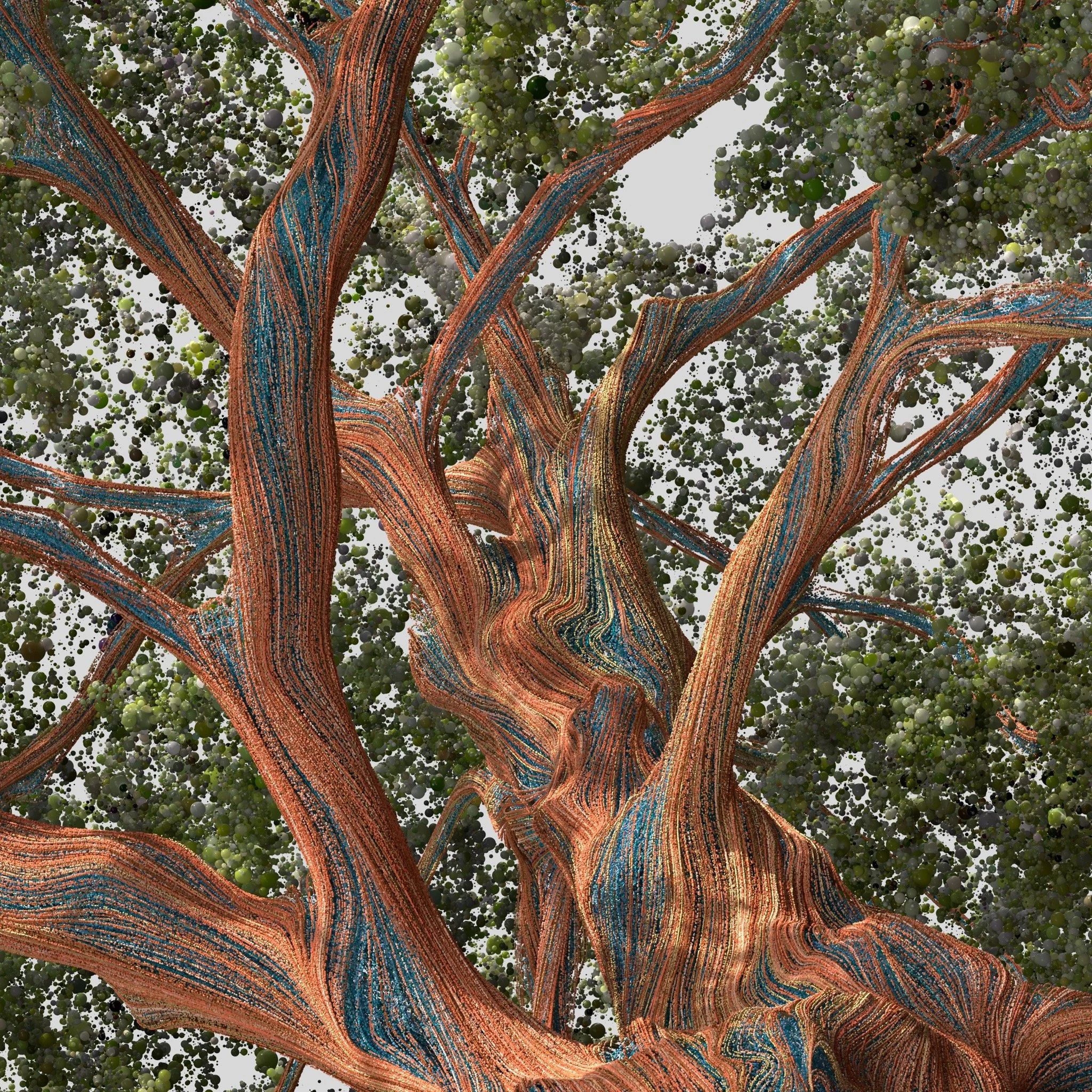
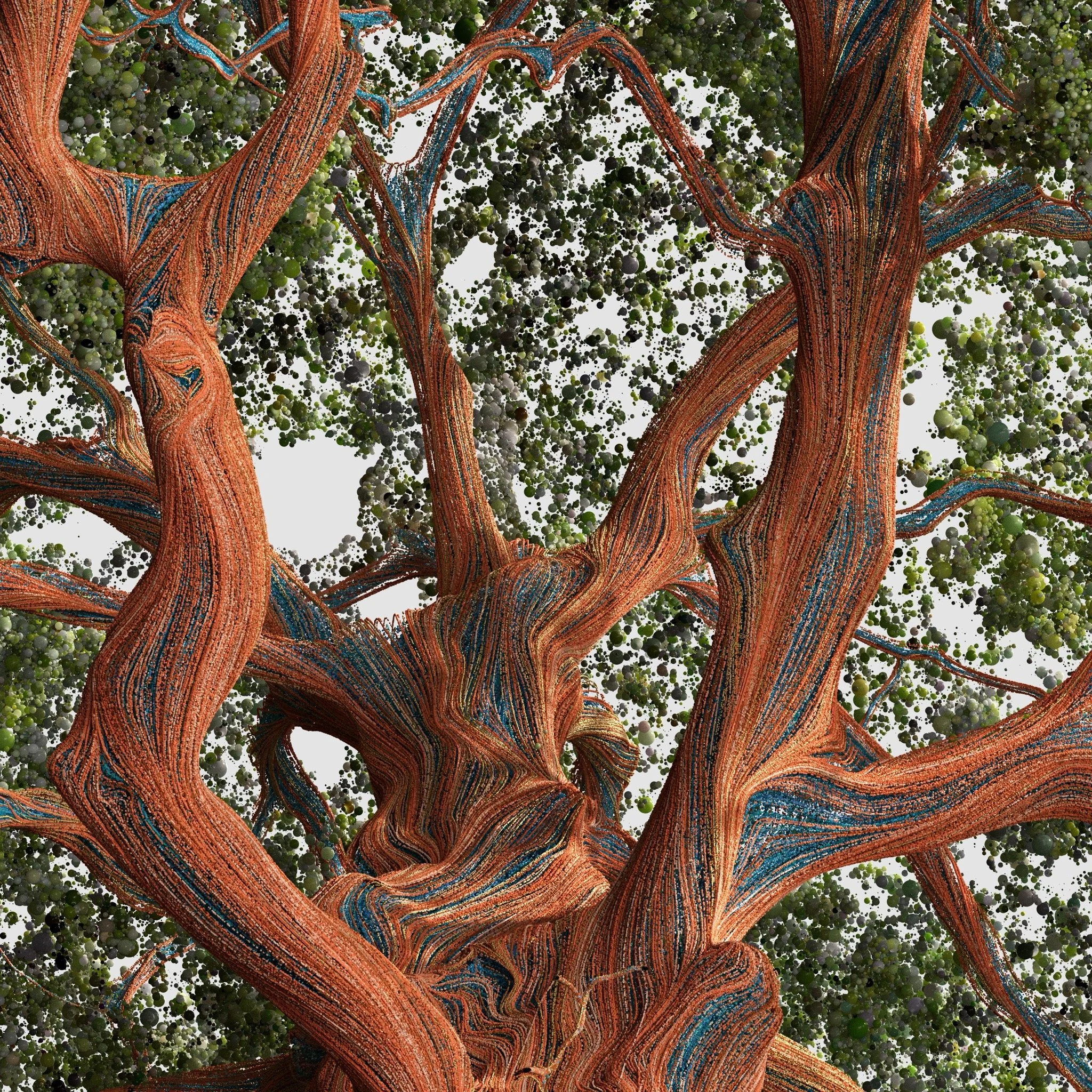
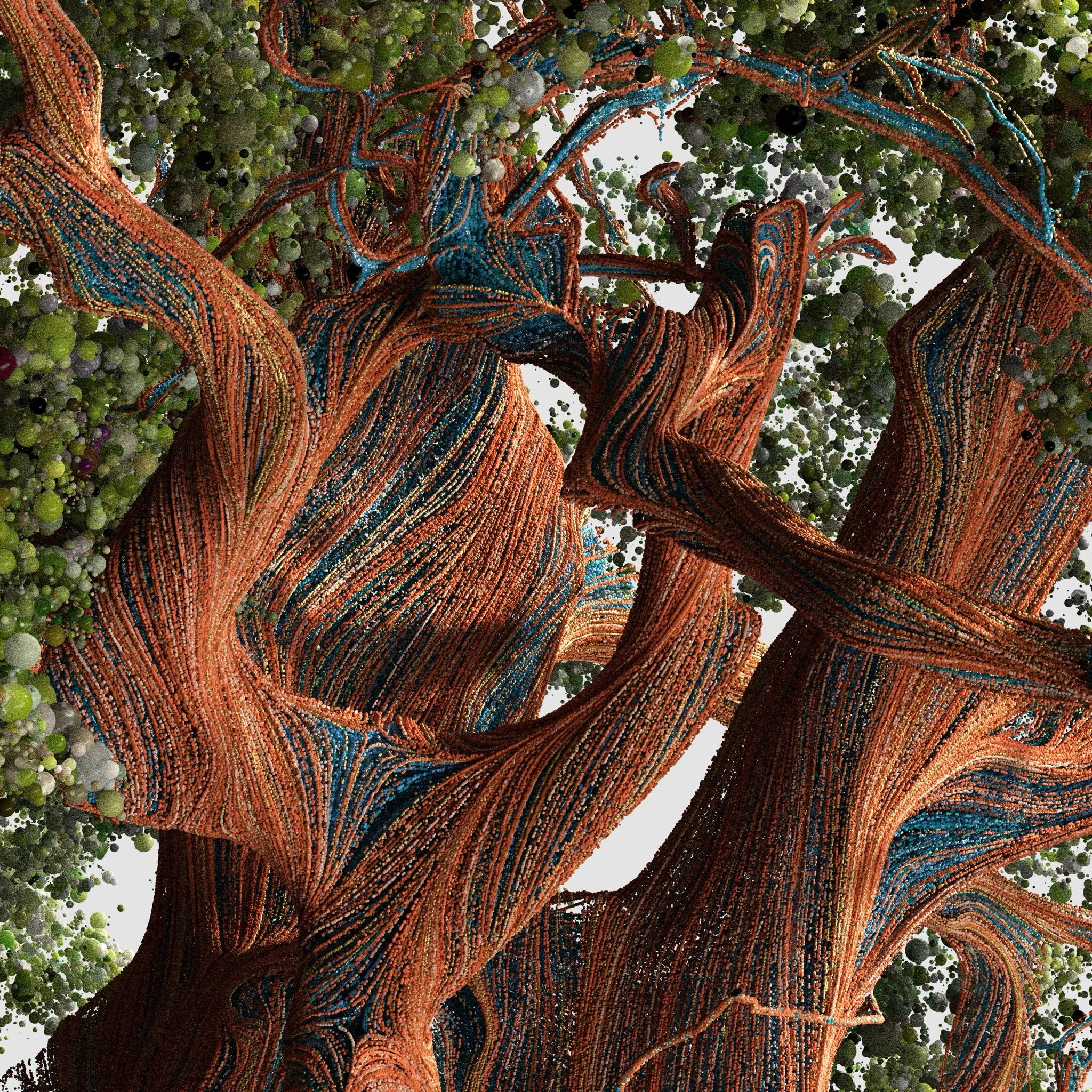
Excerpts from the digital artwork, Of the Oak, Courtesy of Marshmallow Laser Feast, 2025
Below ground we turned to high-resolution CT scanning. Soil samples from around the Lucombe Oak were scanned at the Natural History Museum’s Imaging and Analysis Centre, revealing the architecture of fine roots, the composition of the soil and the microhabitats held within it.
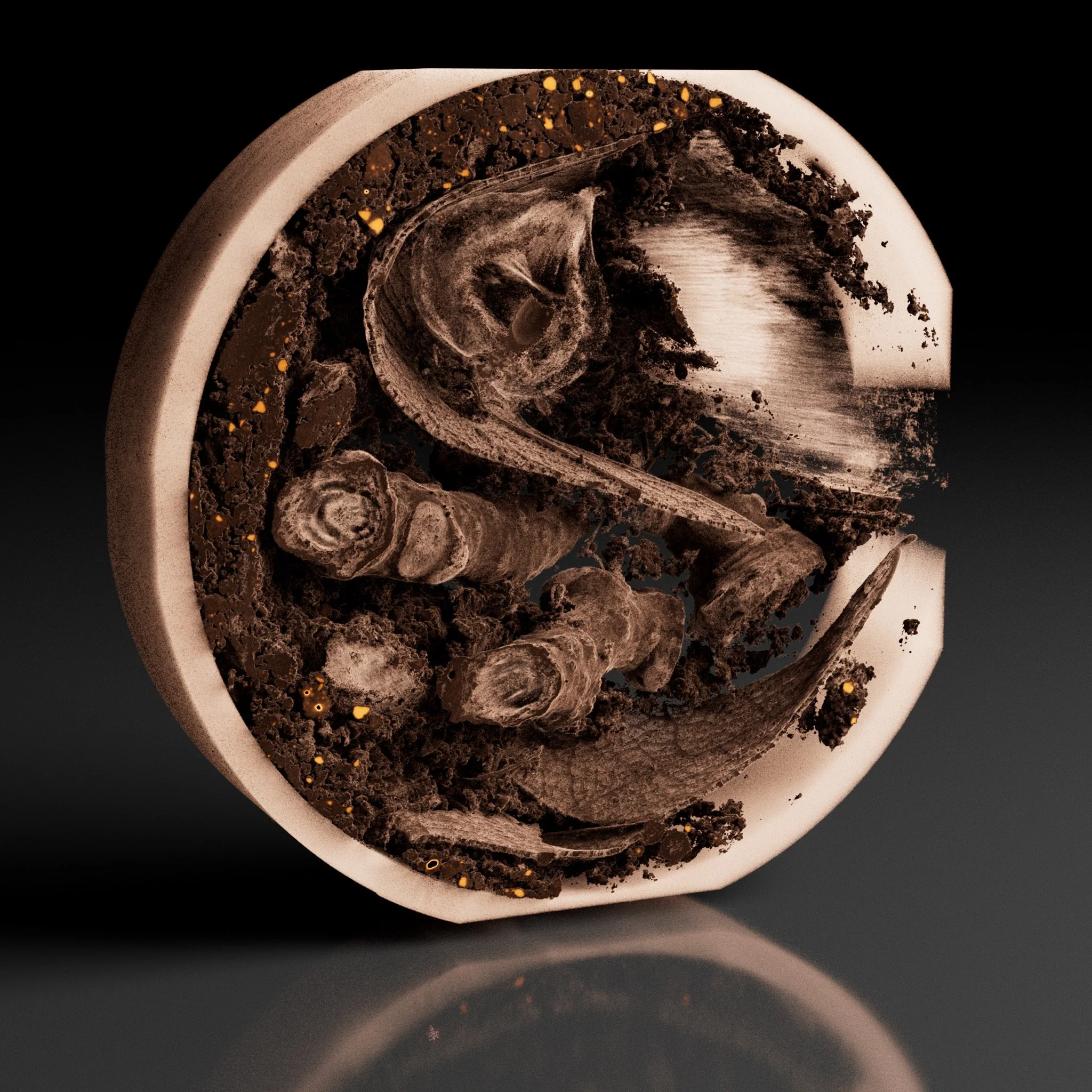
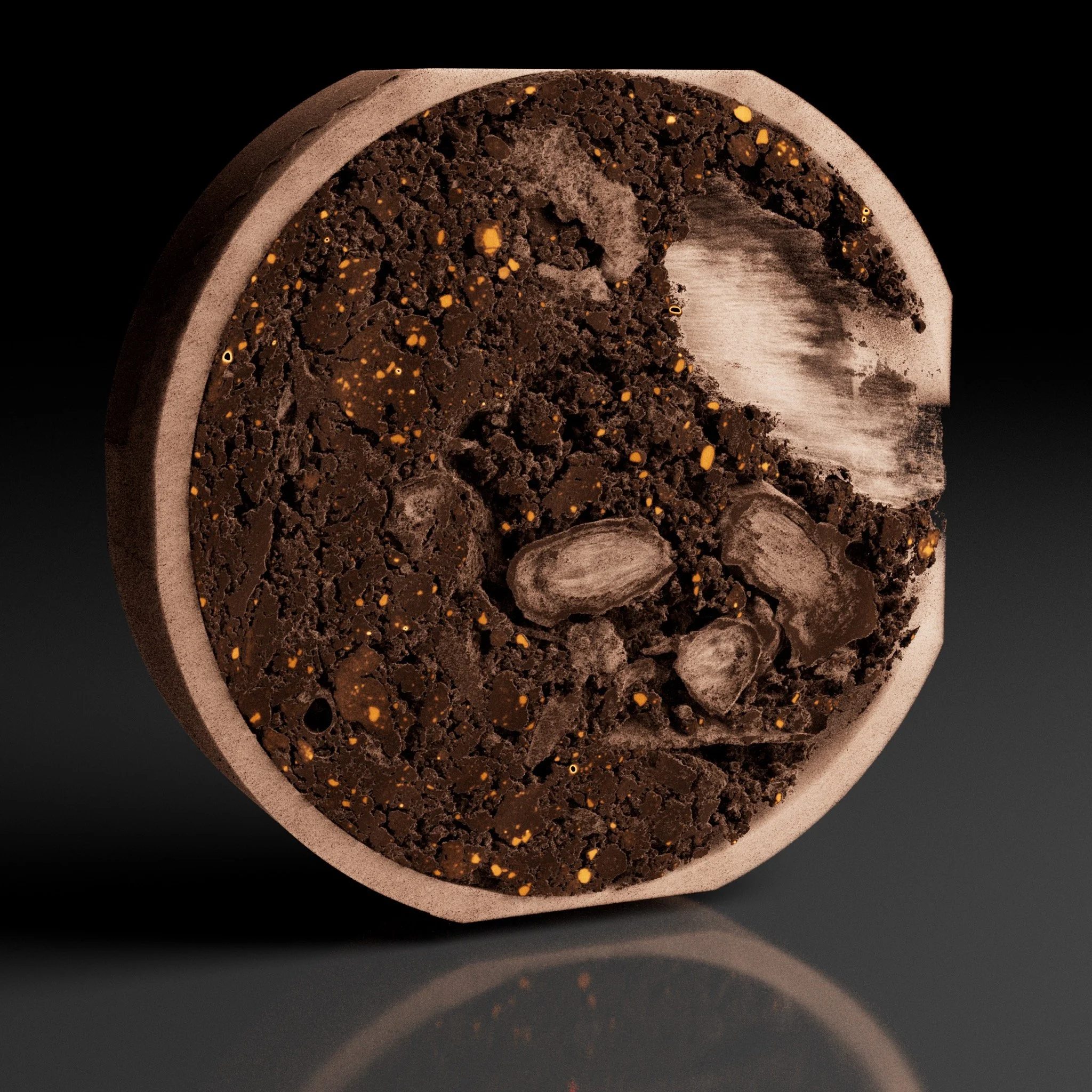
CT scan data of the Lucombe Oak Soil samples, Scanned in NHM imaging and Analysis Centre.
Courtesy of Marshmallow Laser Feast, 2025
Composer and spatial audio artist James Bulley, in collaboration with the Tree Gang at the Royal Botanic Gardens, Kew, set up a multichannel microphone array designed to capture the life around the oak. From the creak of branches swaying in the wind to the gentle rustle of leaves, from the subterranean murmurs of root systems to the bustling activity of creatures that inhabit its bark, this setup reveals the oak’s sonic landscape.
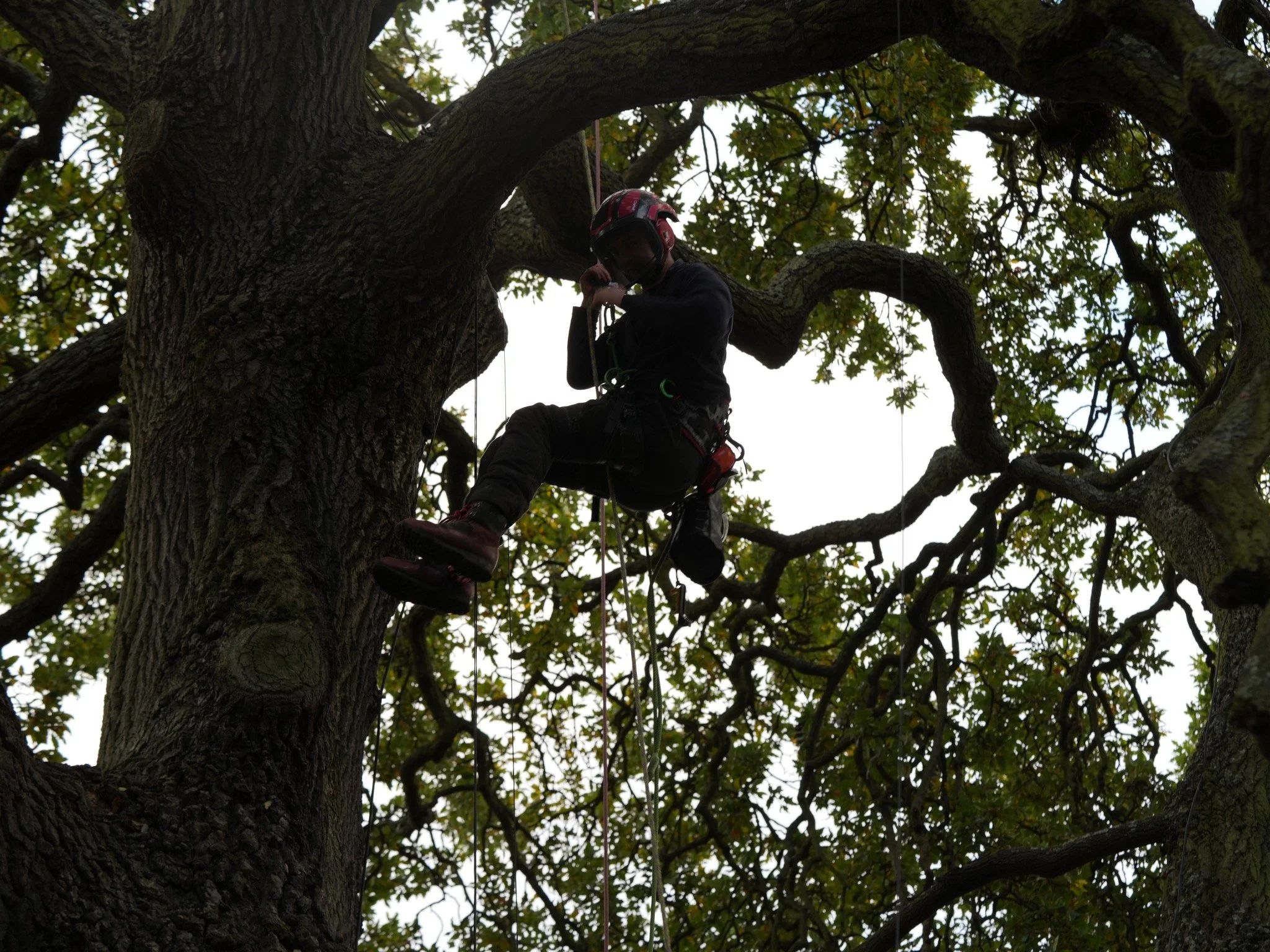
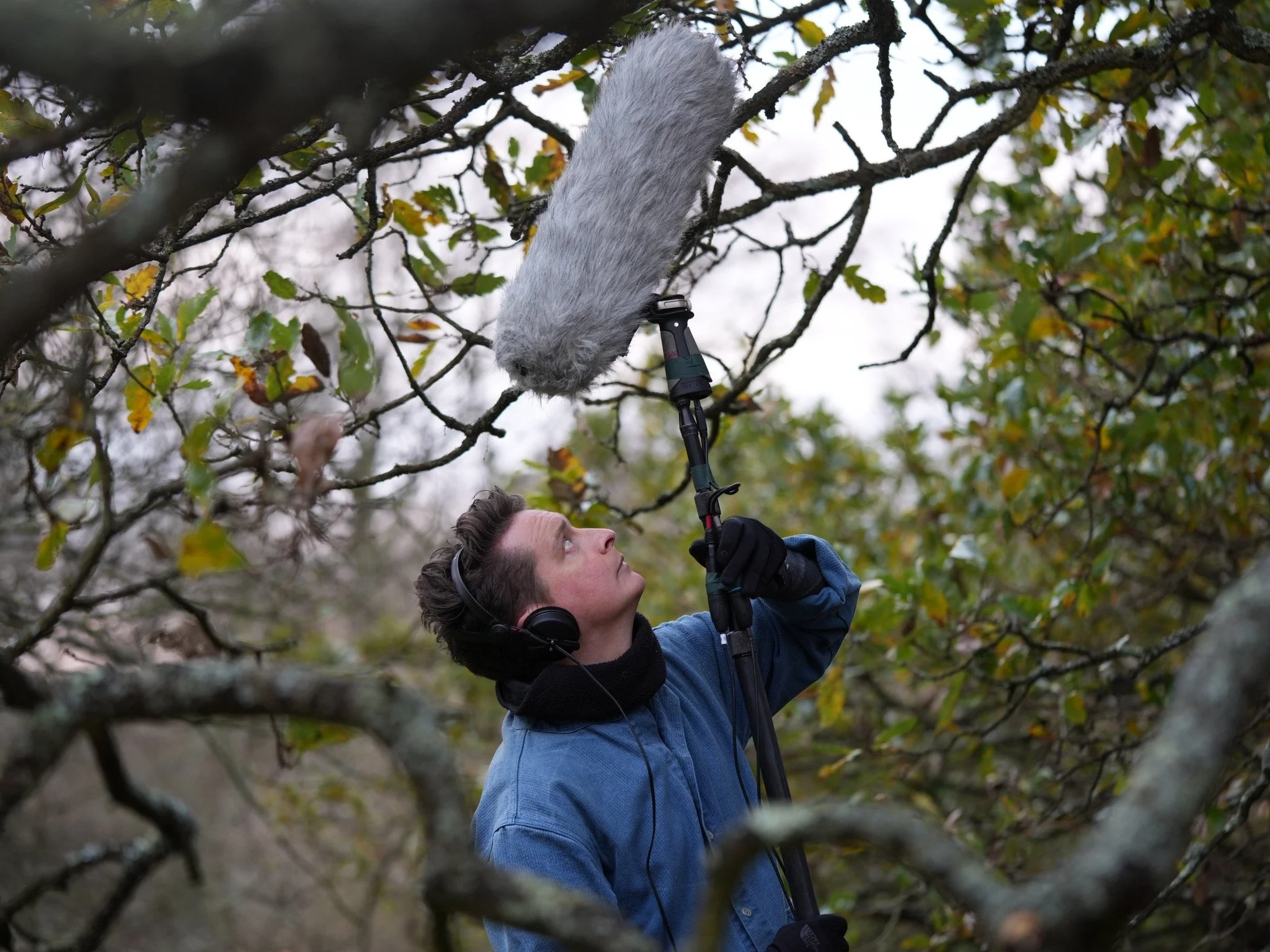
Field recording process around the Lucombe Oak. Courtesy of James Bulley and Marshmallow Laser Feast, 2025
The recordings aim to create an immersive soundscape that allows audiences to listen deeply to the oak’s presence, its respiration, its resonance and the countless interwoven relationships it sustains.
Since its premiere at Kew, Of the Oak has travelled. Last winter it was presented in the 18th century chapel at Yorkshire Sculpture Park, where the stillness of the building turned the work into a place of communion with trees. It is now in Shanghai, shown in the open air at Jing’an Sculpture Park as part of Shapes of Becoming. The Lucombe Oak remains at Kew. Its double carries the same invitation to audiences far from it: to sense a tree not as a towering form, but as a living system.


Questions of the Oak
All that scanning and listening kept leading us back to questions, which we put to ourselves and to the scientists we worked with. Some of them were naive. Why are trees essential to life? What is our relationship to them? Where does a tree end and the world begin? The more we looked, the harder that last one became to answer. An oak is less a solitary being than a living system, offering food and shelter to thousands of species. It breathes, exchanges nutrients and communicates with its surroundings, and the air it exhales becomes our breath. Its branching roots even mirror the networks inside our own bodies. There is more to an oak than meets the eye.
And we have been part of that system for a very long time. People have lived alongside oaks across the Northern Hemisphere since the last Ice Age, and the trees have shaped the human journey ever since, giving us food, shelter, ships, spirits and stories. Britain alone is home to more ancient oaks than all EU nations combined.²
That relationship is now at risk. Oaks are under pressure from several directions at once: rising temperatures, shifting rainfall, invasive pests and emerging diseases, all made more intense by a rapidly changing climate.³ The UK has around 172 million oaks², and Action Oak warns that without urgent action we risk losing the oak as a defining feature of our landscape.⁷ So what is at stake when a species like this falters, and what else falls with it? A tree is never alone. When even a single mature oak goes, the loss ripples out through every species that relied on it for food, shelter and stability.⁴
Of the Oak grew out of these questions. It is a celebration of oaks, and it is also a call to artists, scientists, storytellers and custodians like Kew Gardens to nurture and protect the relationship.⁵ To tell the oak’s story in poems, books and installations, but also in policies, in landscapes, in hearts and homes. Because if we don’t, the oak may survive only as a memory.
Ersin Han Ersin
Marshmallow Laser Feast
2026
Of the Oak website, field guide and guided meditations.
Website
https://marshmallowlaserfeast.com/work/
https://www.instagram.com/marshmallowlaserfeast/
Footnote
1. Mitchell, R.J., et al. (2019). OakEcol: Oak-associated biodiversity in the UK. Data Brief 2019 Jun 10:25:104120.
2. Action Oak. (2024). Action Oak Report 2023–24. Available from: https://static1.squarespace.com/static/661d06655b6f6f4cb2679987/t/663b6be7d6a3b6550fcc3904/1715170474547/Action+Oak+Report+2023-24
3. Martin, K. (2025, April 17). Interview with Kevin Martin, Head of Tree Conservation at Royal Botanic Gardens, Kew [Interview].
4. Mitchell, R. J., et al. (2019). A contemporary assessment of the biodiversity benefits of the UK’s largest native trees. Biological Conservation 234: 136–151. DOI: https://doi.org/10.1016/j.biocon.2019.03.040
5. Action Oak. (n.d.). Projects. Available from: https://www.actionoak.org/projects
6. James Hutton Institute. (n.d.). Decline of Oak. Available from: https://www.hutton.ac.uk/node/15936
7. Action Oak. (2026). State of the UK’s Oaks: Summary analysis. Available from: https://www.actionoak.org/state-of-the-uks-oaks